Have you ever visited a big warehouse or a factory with poor air quality? If so, you might be asking yourself, ” Why is the air there so bad?” It is because industrial facilities have plenty of stagnant air. It gets heated up and it cannot escape. As a result, fumes and dust particles accumulate inside the building.
While air quality is crucial for the comfort of people working there, it can also impact their health. That is why factories and warehouses usually buy special equipment. They install air purifiers to improve the conditions in such facilities.
However, many companies still face problems related to airflow in the buildings. The solution is quite obvious. Industrial ceiling fans are supposed to solve that issue. Let us look at them in detail.
Functioning of Industrial Ceiling Fans
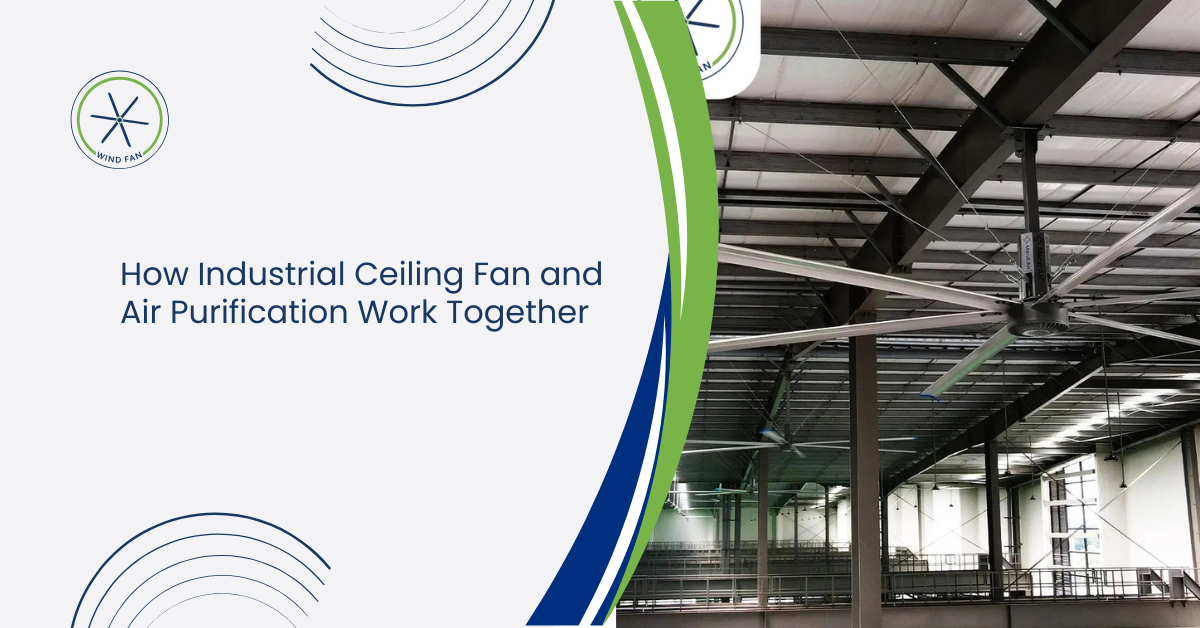
High Volume Low Speed (HVLS) fans are created to move substantial amounts of air slowly. Instead of generating sharp gusts, they create a consistent flow.
In simple terms, this means that any space where they are installed will have constant airflow. The hot air that accumulates in the corners of the room moves down and mixes with cooler air. This is called the destratification process.
That is why workers tend to feel better when they stay in the vicinity of such fans. With constant airflow, there are no areas that lack ventilation. Moreover, HVLS fans make people feel cooler due to the airflow effect.
How Air Purification Systems Work?
As for air purification, these systems are designed to eliminate harmful substances from the atmosphere. These could be dust, fumes, pollen, bacteria, or other particles found in such facilities.
Air purifiers use different technologies to achieve that goal. Filters, electrostatic precipitators, or UV lamps can be used to capture pollutants and neutralise them. In this way, these devices can increase the air quality indoors.
However, many businesses forget that even the most advanced air purifier needs airflow. Otherwise, it will not reach certain places and the air in those areas will not be clean. Therefore, companies need to buy two systems and combine them.
How Industrial Ceiling Fans and Air Purification Can Work Together?
The idea behind these two technologies is pretty straightforward. While HVLS fans distribute air within the space, air purifiers filter out all pollutants. Thus, a consistent flow of air ensures that there will be no pockets of polluted and unpolluted air indoors.
Yes, adding another device might seem to be an extra cost for a business. However, the two systems complement each other perfectly. On the one hand, fans help to improve the efficiency of purifiers by distributing air faster. At the same time, purified air will move through the facility easily and cover the entire space.
Benefits of Such Integration for Your Business
There are several key benefits you will receive thanks to these two technologies. First, they will allow you to ensure constant airflow and filtration of air in your facility.
Second, the combination of the two systems will contribute to better energy efficiency and sustainability. For example, fans consume less electricity compared to HVACs. They also prevent dust from accumulating in certain spots. As a result, the lifespan of filters will be extended.
Conclusion
Now you understand why industrial ceiling fans and air purifiers are complementary. While the first devices ensure consistent airflow, the latter ones remove harmful substances from the air. In this way, companies can achieve high air quality indoors.
At the same time, using both systems contributes to higher energy efficiency. That is why such integration is recommended for companies that need to improve working conditions for employees. Contact Wind Fan to know more!