The cost of energy keeps growing every day. The pressure on environmental protection grows every year as well. Large industrial, warehouse and commercial spaces spend vast amounts of electricity. Overheating systems waste even more resources. But have you ever thought about how you could make your building environmentally friendly? High Volume Low Speed, or HVLS, technology will provide you with the best answer to this question.
What Is HVLS?
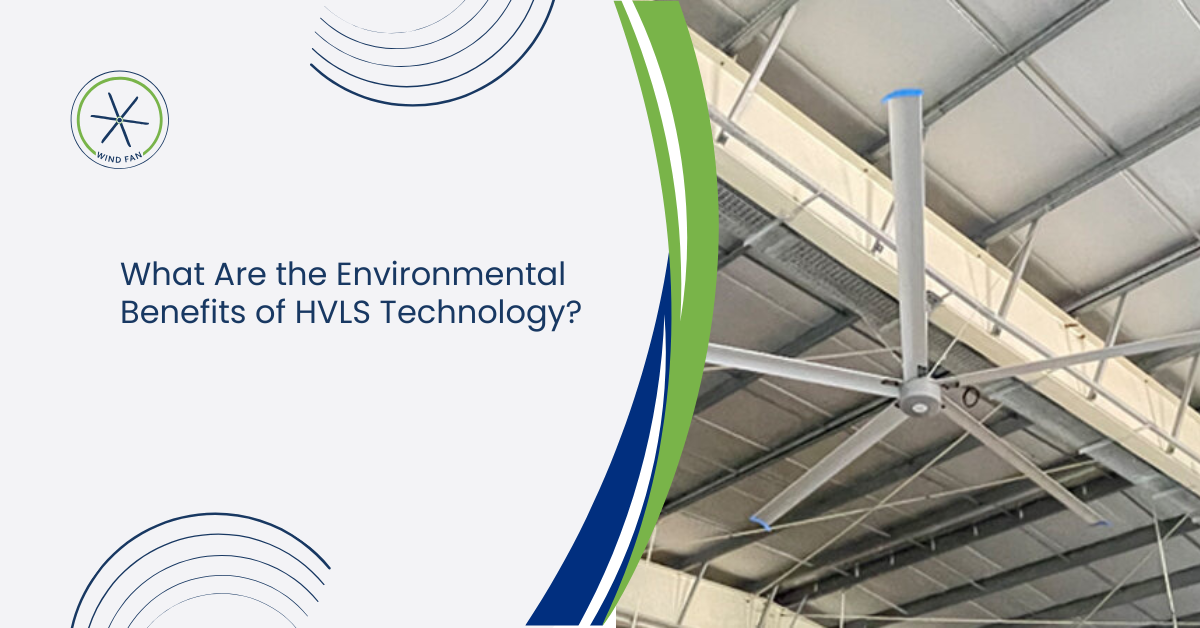
HVLS fans are big ceiling fans which are designed to move large volumes of air at slow speeds. Contrary to regular fans with high speeds, they create a consistent airflow.
To put it simply, this technology will help you save energy by providing more efficient air circulation.
Besides, HVLS fans improve air distribution inside the entire space. Thus, temperature regulation becomes more uniform.
If you have ever felt an unpleasant temperature difference in your warehouse, then we know how uncomfortable it is. In most cases, inefficient airflow leads to such problems.
Decreased Energy Consumption
Firstly, the most noticeable environmental benefit from HVLS technology is the reduced energy use.
Regular air conditioners consume enormous amounts of energy. HVLS, however, lowers the need for continuous mechanical cooling.
Secondly, these fans increase the efficiency of air distribution systems. Due to the improved airflow, thermostats may be adjusted several degrees upwards.
This, in turn, significantly reduces energy consumption.
Less energy means fewer greenhouse emissions. Thus, the impact of a business on the environment is reduced.
Improved Air Quality
Another environmental aspect that can be improved thanks to HVLS technology is air quality.
Still air leads to dust accumulation. HVLS fans create a constant airflow which prevents such issues.
What is more, consistent airflow leads to lower humidity and, consequently, prevents mould and other odours from accumulating.
If you have ever experienced stale air in a large industrial or commercial facility, we know what it feels like. Lack of proper ventilation causes it. Thanks to HVLS technology, the issue can be easily solved.
Higher air quality leads to healthier working conditions. As a result, employees feel more comfortable.
Assistance in Achieving Sustainable Building Targets
Nowadays, many companies pursue sustainability goals.
HVLS technology can assist you in achieving these objectives. Since it consumes less energy, it has a smaller impact on the environment.
Besides, these fans require minimal maintenance as opposed to air conditioning units. Less servicing means reduced material waste.
In addition, these systems last much longer than traditional air-conditioning devices. Thus, they reduce resource usage.
Efficient Heating During the Colder Period
It is important to mention that the environmental benefits provided by HVLS technology are not only applicable in summer.
During winter, HVLS systems perform the process of air distribution called destratification. This process redistributes warm air from the ceiling and mixes it with cooler air.
Thus, the usage of the heating system is lowered and, therefore, energy consumption is reduced.
How can an industrial fan lower heating costs? During cold seasons, the rotation speed of fans should be increased. This way, the redistribution of warm air is achieved.
Long-Term Environmental Effects
Small measures lead to big results.
Decreased electricity usage leads to lower strain on the power grid. Besides, fewer emissions lead to less polluted air.
With time, energy-efficient solutions become a part of a company’s operations. HVLS fans provide consistent performance without any additional expenses.
Conclusion
It is safe to say that HVLS technology offers numerous environmental benefits. Such fans decrease energy use, improve indoor air quality and help to achieve sustainability targets. Besides, they reduce energy expenditure in colder periods due to destratification.
At Wind Fan, we produce HVLS fans which provide reliable airflow and reduce energy use. Our products are perfect for contemporary commercial and industrial spaces.