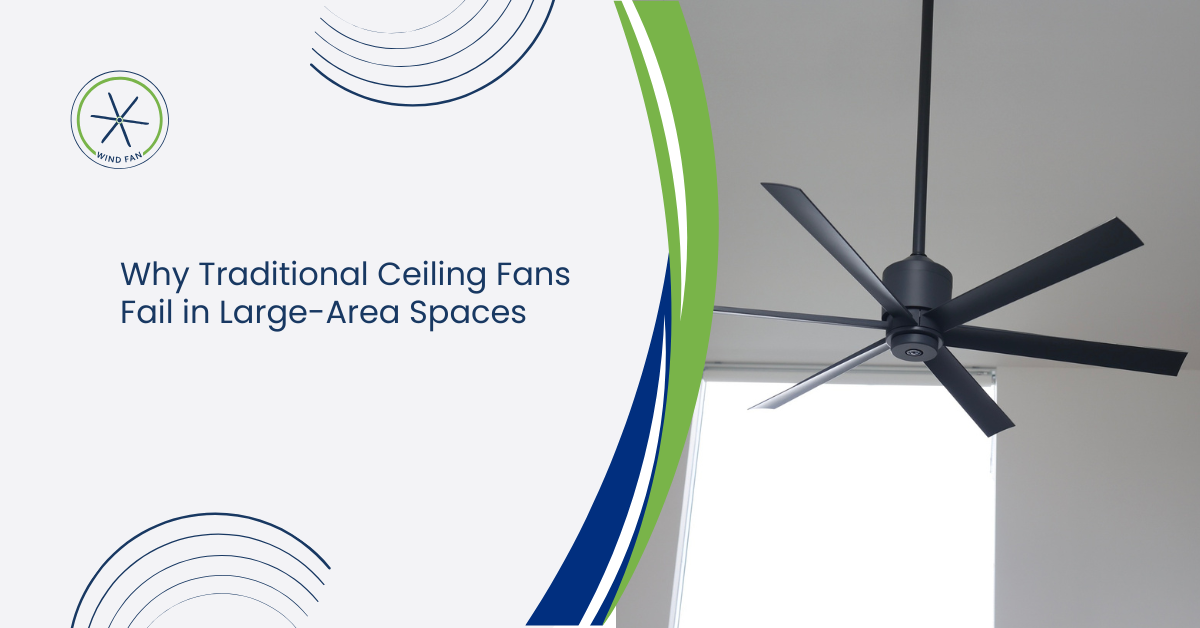
It can be tiring to manage airflow in a big factory or warehouse. The heat rises. People get tired. Hot machines. The room still feels uncomfortable even after putting up several ceiling fans. A lot of factories in India have this problem. Ceiling fans that are made for small rooms are not made for big industrial floors. A lot of businesses still depend on them and expect results, though. When the cooling system breaks down, work slows down. People’s spirits drop. The cost of electricity goes up.
So, it’s important to know why regular ceiling fans don’t work well in big rooms and what better options there are.
1. Limited Air Coverage
First, regular ceiling fans are meant for homes and small offices. The blades are short. The air that comes out of them only spreads out in a small circle below the fan.
Ceilings in big factories can be 20 feet or more high. The air loses strength before it hits the ground because of this height. Because of this, the workers below don’t feel much better.
Some places are still hot, while others feel a little cooler. This uneven airflow makes things uncomfortable. Workers are unhappy. It gets harder to control the temperature.
So, using a lot of small fans doesn’t fix the main problem. It only spreads weak air flow over a large area.
2. Bad performance in rooms with high ceilings
pushed down well by regular fans.
Because their motors aren’t made for that height, the airflow gets weak and scattered. So, the lower working zone stays warm and stuffy.
This has an effect on how much energy workers have. It also has an effect on how well machines work.
But real industrial fans are made to move air both up and down and side to side. They make a steady stream of air that goes all the way to the ground.
The whole room feels balanced when the air flow is strong and steady.
3. A lot of energy is used, but not much happens.
Many places put in more than one ceiling fan to help the air flow. But using several small fans at once uses more electricity.
Even then, the cooling isn’t very good. So, the cost of energy goes up without any real comfort.
Management teams find this situation to be annoying. Money is spent, but the results are not very good.
On the other hand, big industrial fans are made to move a lot of air slowly. So, they use less power and cover more ground.
Better airflow and lower electricity bills make things work better.
4. Noise and Problems with Maintenance
When used at high speed, regular ceiling fans can get loud. Adding noise to factories where machines already make noise makes things more stressful.
It might be hard for workers to talk to each other clearly. Over time, noise fatigue gets worse.
Also, it becomes harder to keep up with maintenance when there are a lot of fans. Each unit needs to be cleaned, checked and fixed every now and then.
This makes downtime longer. Costs for maintenance go up.
But bigger industrial fans mean fewer units are needed. Fewer machines make maintenance easier and less disruptive.
5. No way to control airflow
There aren’t many ways to control traditional fans. The settings for speed are simple. You can’t change the direction of the air properly.
In big buildings, the airflow needs are different. Some areas need more cooling power. Some people need ventilation that is balanced.
Some places feel too warm and others feel breezy without flexible control.
It’s easier to control the speed and direction of airflow with modern industrial fans. Because of this, cooling becomes more even.
Uniform airflow makes things more comfortable and puts less stress on HVAC systems.
The Better Option
For large areas, you need solutions that are made just for them. Industrial fans that move a lot of air at a low speed are made just for warehouses, factories and commercial halls.
These fans move a lot of air in a gentle but effective way. They make the air flow better, lower the humidity and keep the temperature even from the ceiling to the floor.
This makes the environment cooler and more productive.
Conclusion
Traditional ceiling fans might work well in small rooms. But they don’t work well in big factories. For large buildings, they are not very useful because they don’t cover a lot of ground, don’t move air well, use a lot of energy and are hard to keep up with.
So, moving up to purpose-built industrial cooling solutions is a smart and useful choice.
WindFan is the best choice for advanced and reliable large-area cooling systems. The right solution keeps industrial spaces cooler, safer and more productive all year long.